Behind the sound: three loudspeaker design stories
A speaker demonstration in Vienna, a new Danish tweeter and a natural-fibre cone: follow three ideas from the hidden motor to the listening room.
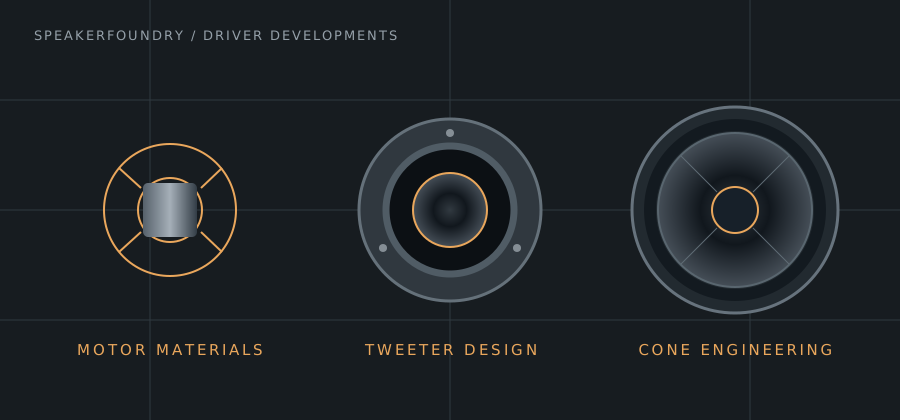
Original concept illustration by SpeakerFoundry. The links in each story open photographs of the actual products on their manufacturers’ websites.
The next interesting change in a loudspeaker might be tucked behind its cone, hidden in the shape around its tweeter, or woven into the diaphragm itself. Follow those three clues and a familiar object starts to look more interesting. Our story begins with a speaker demonstration in Vienna.
A familiar speaker, with a different magnet story
See the actual Carmel 3 in YG’s gallery ↗Standard product gallery; the Vienna demonstration’s motor differs.
On 4 June 2026, Niron Magnetics announced a collaboration with YG Acoustics and Scan-Speak at High End Vienna. The demonstration centred on YG’s Carmel 3 loudspeakers, fitted with proprietary drivers using Niron’s iron-nitride permanent magnets.
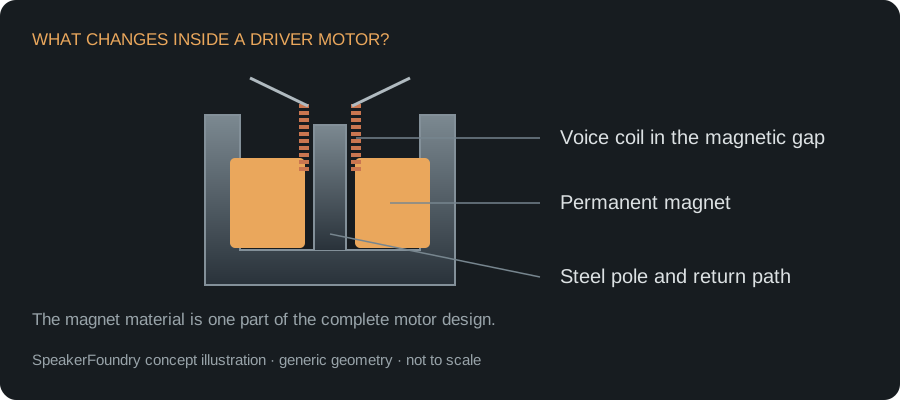
The change sits deep inside the driver. The companies describe these magnets as rare-earth-free, bringing a different material route to a component that helps turn an electrical signal into cone movement. For a loudspeaker builder, that opens an interesting question: how might a new magnet material influence the way future motors are designed and supplied?
The demonstration is one chapter in that story. YG’s current standard Carmel 3 page still describes neodymium motor magnets, so the Vienna announcement should be read as a specific demonstration rather than a change to every production Carmel 3. There is more to learn about the motor and its measured performance before drawing conclusions about sound.
Explore the motor concept
The tweeter starts shaping the room
See the actual D2906/972000 tweeter ↗
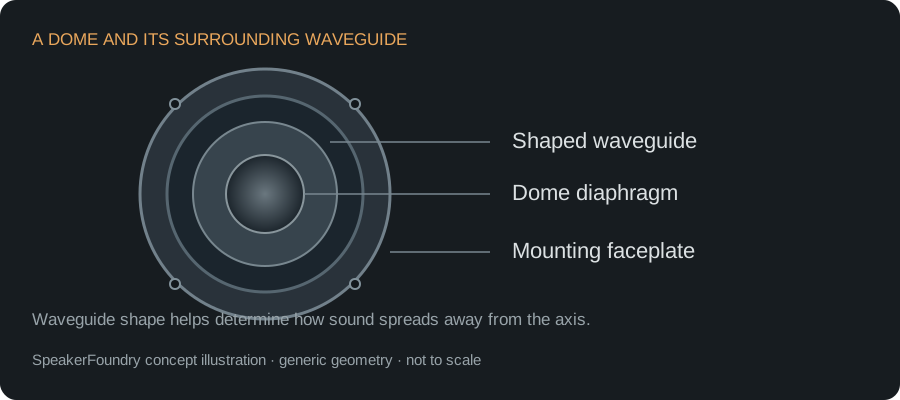
From the hidden motor, move to the front of the loudspeaker. Around a tweeter’s small dome, the surrounding shape can become part of the acoustic design. Scan-Speak’s HERITAGE family brings that idea into focus with the D2906/972000, a 28 mm, 6 Ω dome tweeter incorporating a controlled-directivity waveguide.
A waveguide gives the designer a way to work on the direction in which sound spreads. That makes it interesting when considering how a tweeter and woofer behave together, and how the balance changes as the listener moves away from the central seat. Here, the familiar dome becomes part of a wider design story.
Scan-Speak also lists its SD-2 motor and a low-resonance rear chamber. The datasheet dated 29 May 2026 is preliminary, with power-handling figures still marked TBD. It is a promising design to follow; the latest documentation and measurements should guide any build.
Explore the waveguide concept
The cone brings the story back to familiar materials
See the actual SB17NRX2L35-4 Norex ↗
Then there is the part everyone notices: the cone. SB Acoustics’ SB17NRX2L35-4 Norex offers a useful reminder that modern driver engineering also involves refining familiar material ideas. Its manufacturer describes an in-house cone material containing natural fibres.
Look beyond the cone and the rest of the assembly comes into view: a vented cast-aluminium chassis, a larger motor with an extended copper sleeve, and a vented coil former. These details invite us to examine the complete driver rather than judge it from the cone material alone.
This Norex is an existing catalogue example, rather than a fresh launch announcement. Its published sensitivity is 92 dB at 2.83 V / 1 m, with a nominal impedance of 4 Ω; SB says its T/S parameters are measured after break-in. Those conditions are part of the story whenever we compare it with another driver.
Where the next chapter begins
Three different starting points lead to the same workbench: a magnet material, a tweeter’s surrounding shape, and a cone recipe. Each gives us something concrete to investigate. The next chapter belongs to measurements, thoughtful crossover choices and finished builds. Which would you like SpeakerFoundry to explore first?
Explore the relevant references
Library references are exact models; a related brand link is not a claim that a listed driver uses the demonstrated iron nitride motor.
Sources & editorial notes
Sources reviewed 6–7 October 2026; story revised 7 October. This is an original account of published manufacturer information and our interpretation of its design implications. SpeakerFoundry has not attended or independently tested the Vienna demonstration. Product photographs open on their owners’ websites.
- Niron Magnetics: Vienna announcement, 4 June 2026 ↗
- Scan-Speak: HERITAGE family ↗
- Scan-Speak: D2906/972000 product page ↗
- Scan-Speak: preliminary D2906/972000 datasheet, 29 May 2026 ↗
- YG Acoustics: standard Carmel 3 and gallery ↗
- SB Acoustics: SB17NRX2L35-4 / Norex product page ↗
Datasheets remain external. For a correction, contact the editor →.
Discussion
Questions, evidence and practical experience are welcome.
Comments are reviewed before publication. Keep it constructive, link your sources and avoid personal details. Discussion guidelines →
Loading discussion…
Showing the first 200 comments in this discussion.