KEF puts cone movement inside the control loop
Manufacturer article: 30 July 2026 · reported 9 October 2026
KEF’s July 2026 LS LUXE explanation introduces VECO motion feedback. The story moves from what a driver is made of to how it is controlled.
Most loudspeaker stories begin with a new cone, magnet or enclosure. KEF’s LS LUXE adds another place to look: the relationship between the driver and the electronics controlling it. The interesting question is what happens after an amplifier receives the music.
From a signal to a controlled movement
In a manufacturer article dated 30 July 2026, KEF describes Velocity Control Technology, or VECO, as patent-pending motion feedback used with a current-drive amplifier for the midrange and bass. KEF claims lower distortion and reduced power compression from this approach. Those claims await independent assessment here.
The comparison also identifies a 6½-inch, twelfth-generation Uni-Q driver in the LS LUXE, alongside MAT and Music Integrity Engine processing. These details describe an active loudspeaker system: the electronics are part of the product’s design, rather than an optional amplifier added afterwards.
A different kind of integration
For a passive DIY build, the choices are usually expressed as drivers, components and a crossover. An active design opens another set of relationships to investigate. That does not make one approach automatically better; it changes which parts of the system can be developed together.
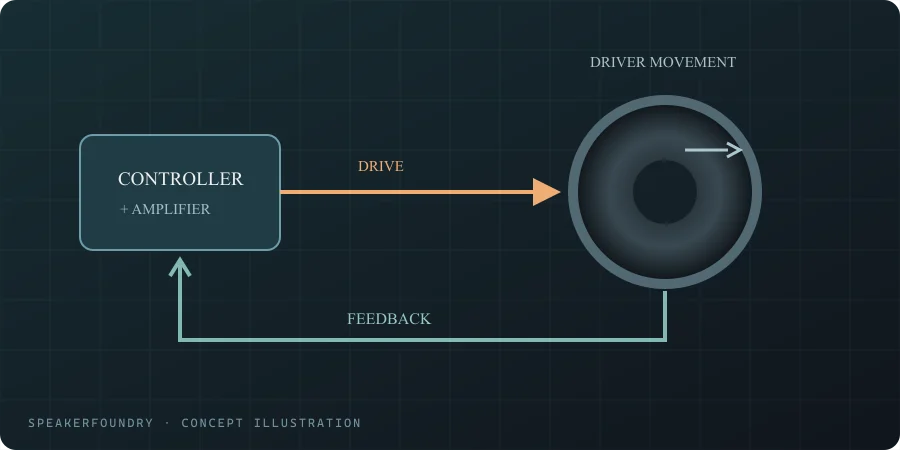
Our illustration shows the general idea of a feedback loop. It is not a diagram of VECO’s proprietary implementation, and it does not imply a listening microphone inside the speaker. Follow KEF’s article for the actual product images and the company’s full explanation.
Follow the story
Sources & image credits
Sources reviewed 9 October 2026. This is an original editorial account of published information; manufacturer performance claims have not been independently tested by SpeakerFoundry. Photos retain their credited owners’ rights and any linked reuse licences. Manufacturer datasheets remain external.
Spotted a correction? Contact the editor →.
Discussion
Questions, evidence and practical experience are welcome.
Comments are reviewed before publication. Keep it constructive, link your sources and avoid personal details. Discussion guidelines →
Loading discussion…
Showing the first 200 comments in this discussion.