Two 15-inch drivers, two very different jobs
Beyma 2026 product announcement · reported 9 October 2026
Beyma’s 2026 additions share a diameter, but the design brief changes when the job moves from sub-bass to mid-bass.
Put two large woofers beside each other and the obvious question is which one goes louder. A more useful question comes first: what part of the music is each one meant to carry? Beyma’s 2026 announcement gives us a neatly matched pair with different answers.
The same size does not mean the same assignment
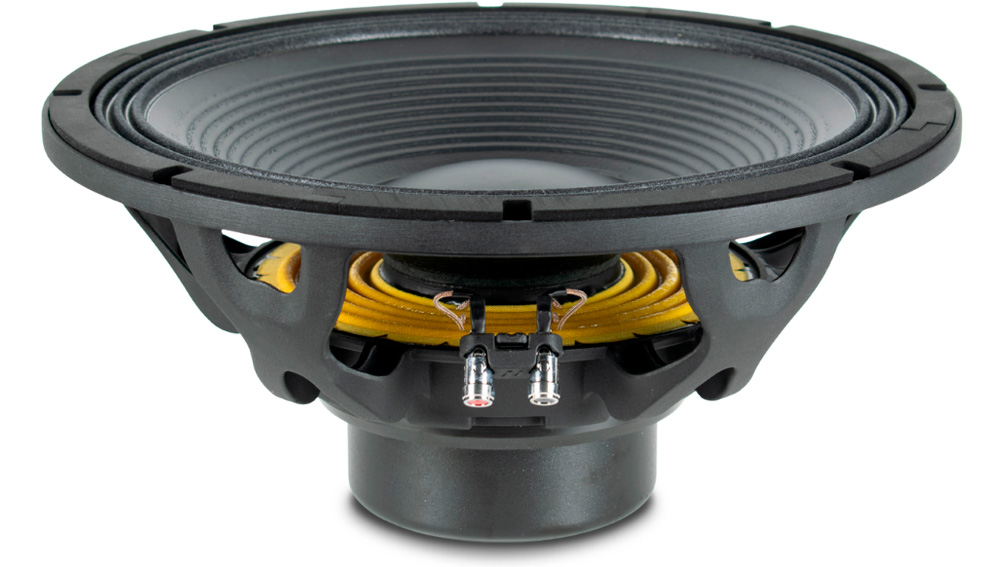
The new 15LEX1200Nd is the sub-bass member. Beyma lists a 36 Hz free-air resonance, a four-inch DUO voice coil and ±11 mm Xmax. Its announcement identifies direct-radiating and band-pass enclosures as intended applications. The pictured product is this 15LEX model, rather than its mid-bass companion.
The 15MLEX1000Nd takes the story higher, with a mid-bass brief for high-output systems. Beyma quotes a 38 Hz resonance and 100 dB sensitivity in the announcement. Both use the company’s Malt Cross cooling approach; the claimed reduction in power compression is Beyma’s description of the technology.
Look beyond the diameter
For the 8 Ω 15LEX1200Nd, the product table specifies 97 dB at 1 W / 1 m at nominal impedance and 1,200 W AES power capacity. Those measurement conditions matter as much as the headline numbers. They describe the driver, not the output of a finished cabinet.
The interesting next step is a comparison of complete designs: intended bandwidth, enclosure, excursion and crossover together. Start with the job, then choose the driver. Which would you build first: a dedicated subwoofer or a system that asks its large cone to cover more of the music?
Follow the story
Sources & image credits
Sources reviewed 9 October 2026. This is an original editorial account of published information; manufacturer performance claims have not been independently tested by SpeakerFoundry. Photos retain their credited owners’ rights and any linked reuse licences. Manufacturer datasheets remain external.
Spotted a correction? Contact the editor →.
Discussion
Questions, evidence and practical experience are welcome.
Comments are reviewed before publication. Keep it constructive, link your sources and avoid personal details. Discussion guidelines →
Loading discussion…
Showing the first 200 comments in this discussion.